Artificial Intelligence feels new.
It is discussed as if it suddenly appeared a few years ago, somewhere between ChatGPT, image generators and the first time somebody discovered that a machine could write a decent email.
It did not.
AI has been around for decades.
In fact, if a computer from 1985 is vintage, then parts of Artificial Intelligence are definitely vintage too.
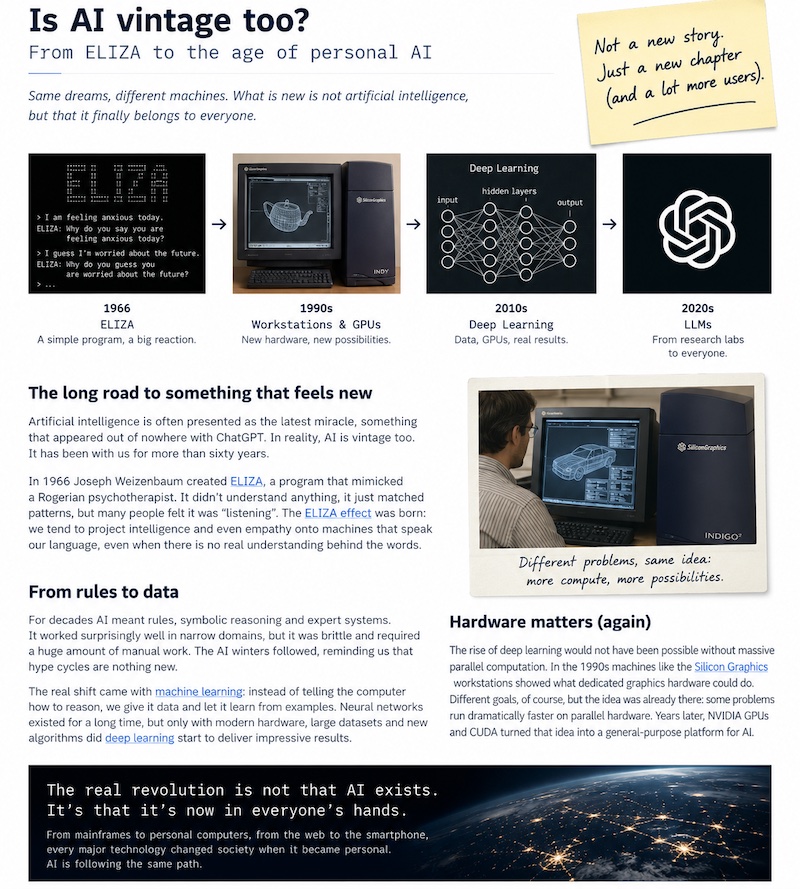
It Started Long Before GPUs
In 1966 Joseph Weizenbaum created ELIZA at MIT.
By today’s standards it was extremely simple. No neural networks, no massive datasets, no GPUs. ELIZA matched patterns in text and generated responses according to predefined rules.
And yet people talked to it.
More importantly, some people felt that it understood them.
That was probably one of the first demonstrations of something we are still dealing with today: humans are remarkably good at projecting intelligence onto a machine when the machine communicates in a convincing way.
ELIZA did not understand language.
But it already showed that the relationship between humans and machines could become more complicated than simply pressing keys and receiving numbers.
When AI Meant Rules
For a long time, Artificial Intelligence was mainly symbolic.
Knowledge was represented explicitly:
facts + rules
      ↓
   inference
      ↓
    answer
Expert systems tried to reproduce the reasoning of specialists. Lisp and Prolog became strongly associated with AI research. Dedicated workstations and expensive computing environments were common.
The idea was straightforward: if intelligence is reasoning, then encode the reasoning.
It worked surprisingly well in narrow domains.
It also proved extremely difficult to scale.
Real life contains too many exceptions, too much ambiguity and too much knowledge that nobody has ever written down as a clean set of rules.
The industry went through cycles of enormous expectations followed by disappointment.
We now call them AI winters.
So even the current AI hype cycle is not particularly new.
From Rules to Data
Machine learning changed the approach.
Instead of explaining every rule to the computer, we started giving it examples.
Traditional software:
rules + data
      ↓
   program
      ↓
   result
Machine learning:
data + examples
      ↓
    training
      ↓
     model
This was a fundamental change.
The computer was no longer being told exactly how to solve every problem. It was learning statistical relationships from data.
Neural networks were not new either. Many of the fundamental ideas had existed for decades.
What changed was everything around them.
More data.
More memory.
Better algorithms.
And, critically, much more parallel computing power.
The GPU Connection
This is where the story becomes particularly interesting from a retrocomputing perspective.
In the 1980s and 1990s, companies such as Silicon Graphics were building machines capable of extraordinary parallel graphics computation for their time.
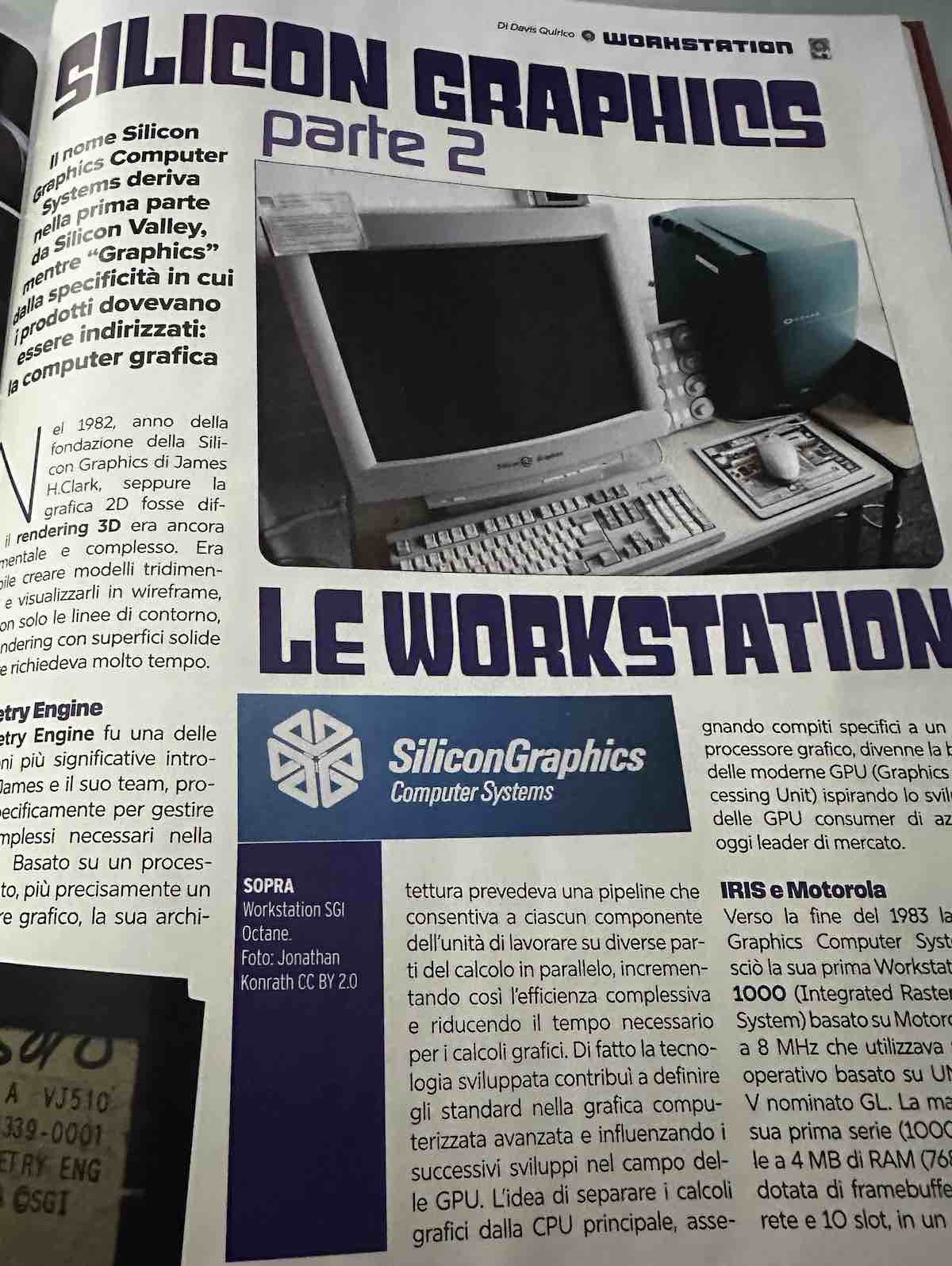
An SGI workstation was not a modern AI accelerator. There was no CUDA, no TensorFlow and certainly no transformer model hiding inside an Indigo or an Onyx.
But the direction was already visible.
Some workloads simply become much faster when large amounts of relatively simple computation can happen in parallel.
Graphics needed that.
Years later, machine learning discovered exactly the same thing.
Programmable GPUs evolved from graphics accelerators into general-purpose parallel processors. NVIDIA introduced CUDA, researchers started using GPUs for neural networks, and suddenly training models that would previously have taken impractical amounts of time became possible.
The hardware built to draw pixels became one of the engines of modern Artificial Intelligence.
That is a fairly remarkable evolutionary path.
Deep Learning Changes the Scale
During the 2010s, deep learning started producing results that were difficult to ignore.
Computer vision improved dramatically.
Speech recognition became practical.
Machine translation improved.
Machines became increasingly good at finding useful representations inside enormous datasets without engineers explicitly describing every feature.
The basic idea was still statistical learning.
But the scale had changed.
And scale turned out to matter much more than many people expected.
Then Came the Transformer
In 2017 the Transformer architecture appeared.
Its key mechanism, attention, allowed models to work with relationships between pieces of information in ways that scaled extremely well.
From there came increasingly large language models.
At the lowest level, an LLM is doing something deceptively simple:
tokens → embeddings → attention → transformer layers → probabilities → next token
This is where discussions often become ideological.
One side says:
It is just autocomplete.
The other says:
It is almost human intelligence.
Both statements are too easy.
Yes, an LLM predicts tokens.
But doing that at enormous scale produces capabilities that were not obvious from the mechanism itself.
It can translate, summarise, write code, analyse documents, explain concepts and interact with software tools.
At the same time, it can confidently invent facts, misunderstand simple problems and produce nonsense with excellent grammar.
That uncomfortable middle ground is probably where reality currently sits.
We Have Seen This Transition Before
The most important change in AI today may not be technical.
It may be accessibility.
The Internet existed long before most people used it.
ARPANET dates back to 1969. TCP/IP was developed during the 1970s. The Web appeared around 1990.
But for most people, the Internet became real much later, when it entered homes during the late 1990s and early 2000s.
Mobile computing followed a similar path.
There were smart mobile devices before the iPhone. But 2007 changed the relationship between ordinary people and computing.
The smartphone became personal, permanent and ubiquitous.
Social networks followed during the 2010s and gave almost everyone the ability to publish globally.
AI is now going through something similar.
| Then | Now |
|---|---|
| Mainframes | Personal computers |
| Networks | Internet |
| Mobile computing | Smartphones |
| Online communities | Social media |
| Artificial AI | Personal AI |
The technology existed before the mass adoption.
What changed was who could use it.
AI Has Become Personal
Until recently, advanced AI was something that happened in universities, research laboratories and very large companies.
Today anyone with a browser can use systems that would have looked extraordinary only a few years ago.
That is the real transition.
The Internet gave people access to information.
The smartphone made that information permanently available.
Social media gave everybody the ability to publish.
AI adds another layer: the ability to manipulate information through natural language.
You can ask a machine to transform a document, explain code, translate a text, analyse data or generate a first version of something that previously required specialist skills.
That does not eliminate expertise.
Quite the opposite.
The better you understand a subject, the easier it is to recognise when the machine is wrong.
And it is wrong often enough to matter.
Between Enthusiasm and Catastrophe
At the moment the public discussion around AI seems to have two settings.
Maximum enthusiasm:
- AI will replace programmers.
- AI will solve science.
- AGI is almost here.
Maximum pessimism:
- It is only hype.
- It understands nothing.
- It will destroy jobs, culture and perhaps civilisation while it is at it.
Reality is probably less dramatic and more interesting.
AI is neither magic nor irrelevant.
It is a powerful new computing interface with serious limitations.
And like every previous major computing transition, it will probably create things we want, things we do not want, and things nobody predicted.
The Internet gave us instant access to human knowledge.
It also gave us spam, phishing and misinformation.
Social media connected billions of people.
It also created an industrial-scale economy based on attention and manipulation.
AI will not somehow escape this pattern.
It can improve productivity, accessibility, education and research.
The same technology can generate industrial quantities of misinformation, automated scams and synthetic garbage.
No artificial consciousness is required.
Ordinary automation at enormous scale is already enough.
So, Is AI Vintage?
In a way, yes.
Its history belongs to the same timeline as mainframes, UNIX, workstations, graphical accelerators and the early Internet.
ELIZA is older than many of the computers we now proudly call vintage.
Neural networks are not new.
Machine learning is not new.
Even the use of specialised parallel hardware has a much longer history than the current AI boom suggests.
What is new is the scale.
And what is genuinely different is that AI has finally escaped the research lab.
It is now on ordinary computers, inside browsers and increasingly in our pockets.
Just as computing became personal, then the Internet became personal, and later the smartphone became personal, Artificial Intelligence is now becoming personal too.
That is probably more important than whether today’s models are truly “intelligent”.
The machine no longer needs to think like us.
It only needs to become useful enough that we start changing the way we work, create and communicate around it.
Leave a comment